November 16, 2026 - 5 min read
Sentinel, rebuilt: a status page you can send to stakeholders
Our open-source monitor for DevOps engineers now looks like a finished product: a public status page, incidents with post-mortems, agents that use it.
Sentinel, the monitor we built for the systems we run, has a new release. It is a tool for DevOps engineers, and it is now a status page you can send to the people who depend on your services, a place to keep incidents and their post-mortems, and a tool you and your agents work in every day. It looks like what it has quietly become: a finished product.
Why we built a monitor at all
Sentinel exists because of a gap we kept falling into. Clients needed monitoring, we needed to see what was happening across the platforms we run, and a lot of the checks we needed were not about whether a server answers. They were about whether the data is right.
A real system fails in ways a ping never sees. Ours handle geospatial data, so the examples came quickly. An API answers 200 while the forecast grid behind it is six hours old. A tile endpoint is up, but the radar layer it serves stopped updating at dawn. A model run never landed in the bucket. A workflow in the cluster did not finish, so nothing downstream will either. A GNSS caster is online, but half the reference stations are missing from its sourcetable.
We tried the usual tools: Gatus, Uptime Kuma, New Relic. Each got about 90% of the way. The missing 10% was always the same part: checks that understand the data. So we wrote a monitor where a check is a short JavaScript function with a small toolkit for exactly those cases: HTTP, FTP, S3-compatible storage (fetch an object, list a prefix, read its timestamps), Kubernetes (did the CronJob or the Argo workflow complete?), and secrets. If you can write the assertion, Sentinel can run it on a schedule, keep the history and tell you when it changes.
Why it needed a rebuild
Sentinel grew the way tools built under pressure grow: one need at a time. Each feature arrived with its own screen and its own words for the same thing. "Down" on one page was "critical" on another and "failing" in an alert. It worked, but it looked like what it was, a Frankenstein, and it was not something you would send to a client.
This release rebuilds every page on one design system and one vocabulary:
- A check is Operational, Degraded or in Outage; Recovered when it is back within the last day; Paused when it is switched off.
- Every state is a shape and a word: a disc, a triangle, a square. Colour never carries a state alone, so the page reads the same for colour-blind visitors and on a grey printout.
- The same words appear everywhere: the dashboard, the public page, Slack and Discord alerts, email, and what agents read.
- Light and dark themes, times in UTC or local, and pages that work on a phone.
A page you can send
The public status page is now the front door. Open the address and you see it: a summary banner, open incidents, then every check grouped by state, with its history over 24 hours, 7 days or 30 days. Tags become pages of their own, so a team can share only the checks that concern a given partner or product.
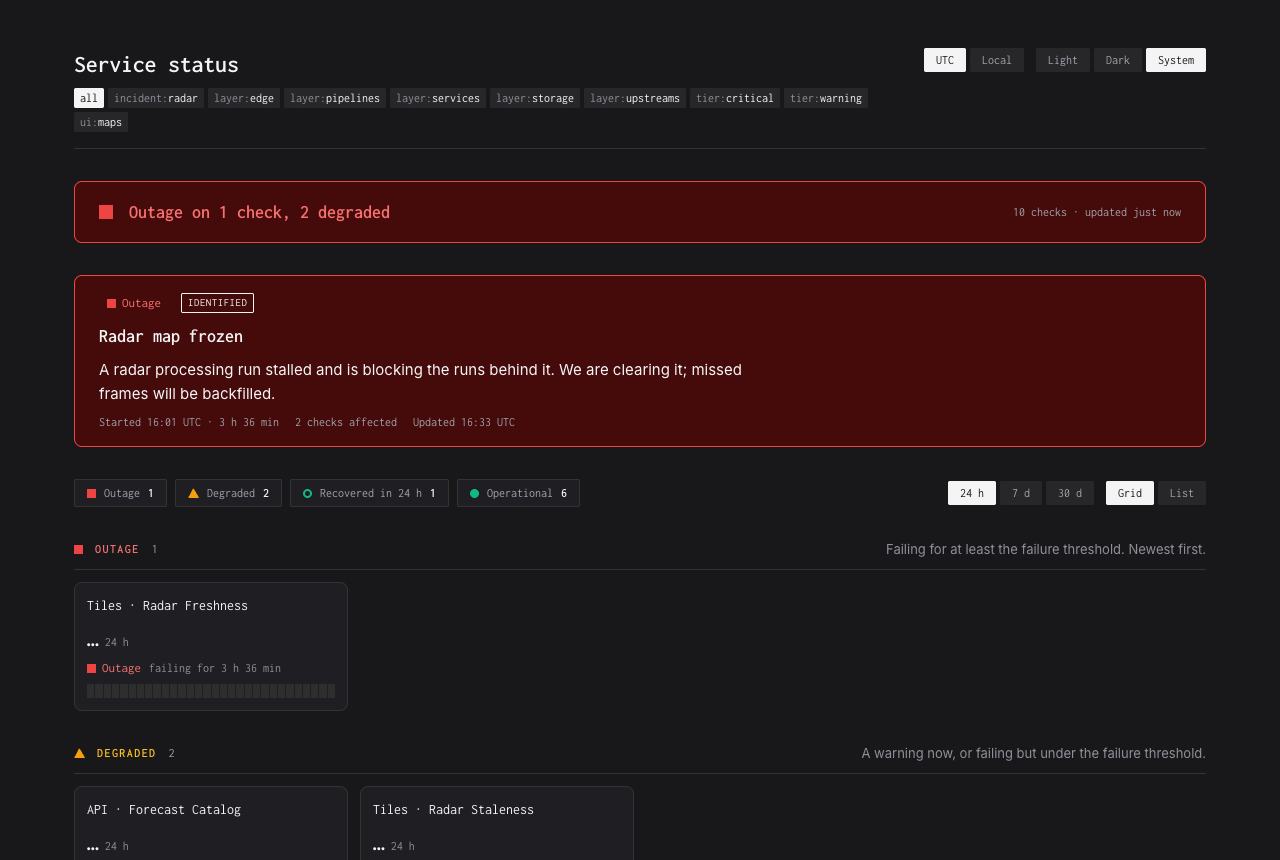
It is built to be sent. Internal error messages never reach the public page, the page refreshes itself every minute, and a stakeholder who opens it at 3 a.m. learns what matters without calling anyone: what is affected, since when, and what is being done.
Incidents you keep
The biggest addition is incidents. When a check reaches Outage, Sentinel opens an incident on its own. Checks that share an incident:<group> tag share one incident, so a stalled processing run that freezes a radar layer and the tiles built from it is one incident, not two alarms. It resolves when every linked check is Operational again.
Each incident has a timeline (what the system saw, plus notes from people) and a report in five sections, with an internal version and a public one. You can keep the full post-mortem for your team and publish the part your stakeholders need.
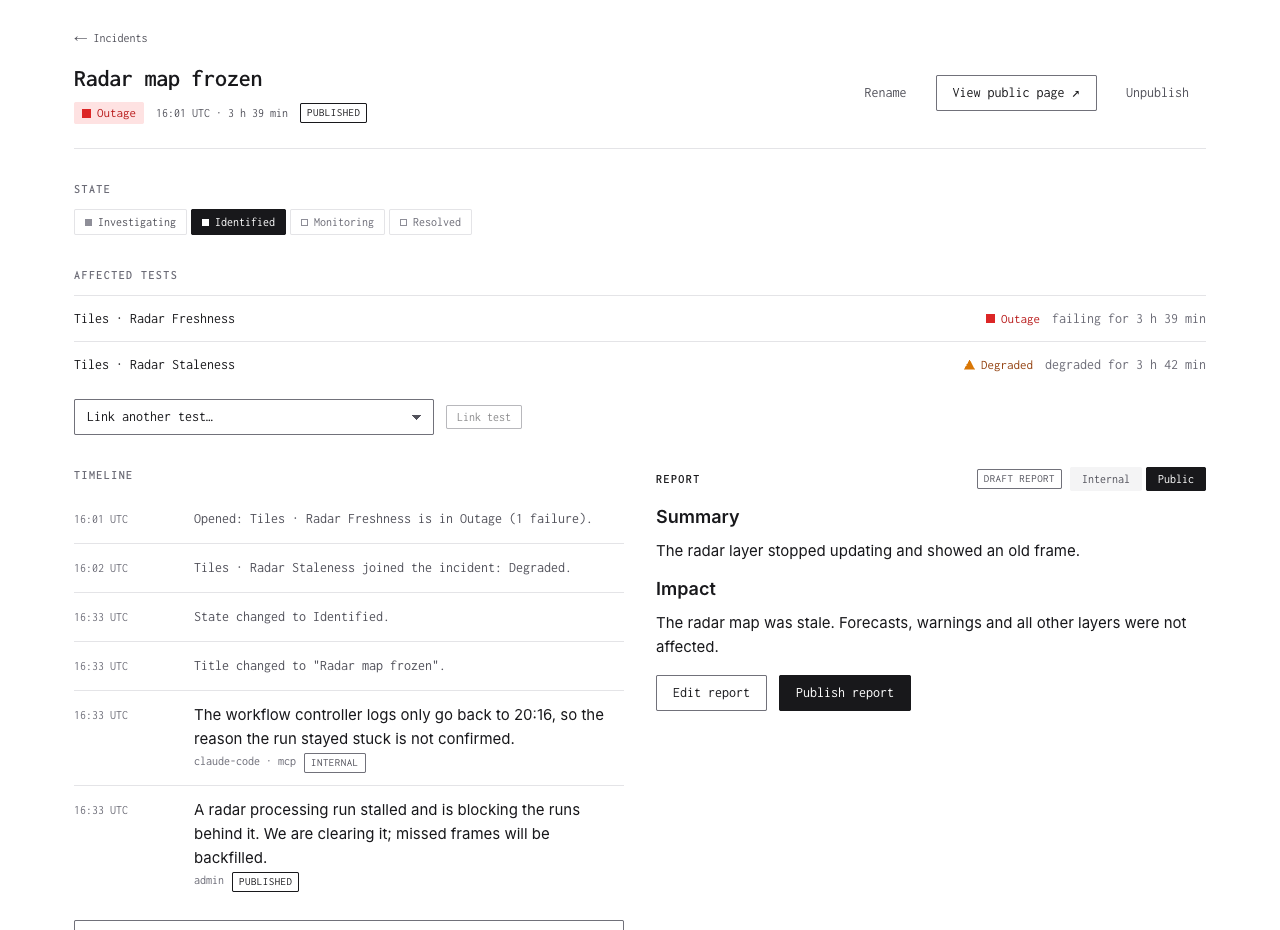
Publishing is deliberately a person's decision. Anyone, or any agent, can write notes and drafts; only someone signed in can put an incident, a note or a report on the public page.
Built for the people and the agents who run it
Sentinel is a public page, but it is first a DevOps tool. The dashboard now has search, filters and bulk actions, so working through dozens of checks after a deploy is a few clicks.
It also speaks MCP, the protocol AI agents use to work with tools. We work with Claude connected to Sentinel every day: it reads the state of every check, opens and annotates incidents, drafts the report, and runs checks again after a fix. It is how we detect what is happening across our platforms and keep track of it. The agent sees the same words you do, and it cannot publish anything on its own.
Under the new face there is a reliability pass too: batched writes, timeouts on every alert, cached public pages, and a scheduler that keeps its rhythm across restarts. It still runs comfortably on a 1 GB virtual machine next to its database.
How to use it
Sentinel is open source under the AGPL v3, at github.com/territorial-dev/sentinel, with a Docker image that starts with one docker compose up.
- Host it yourself, as it is, on your own infrastructure.
- Fork it and make it yours: your branding, your own protocols, your own pages. Next week we will show how, and why it stays easy to update.
- Use it in a closed product or offer it as a service under a commercial licence.
- Or let us run it for you, with the checks your data actually needs.
The tool was never the point. Monitoring a system means checking what it delivers, not only that it answers: how fresh the data is, whether the nightly job landed, whether every upstream is still there. That is the part DevOps engineers end up scripting by hand, and it is why Sentinel exists.