April 22, 2026 - 4 min read
Stop Choosing Between Cron Jobs and Overengineered Pipelines
Why most geospatial pipelines fail in production, and how a simpler workflow layer can provide reliability without unnecessary complexity.
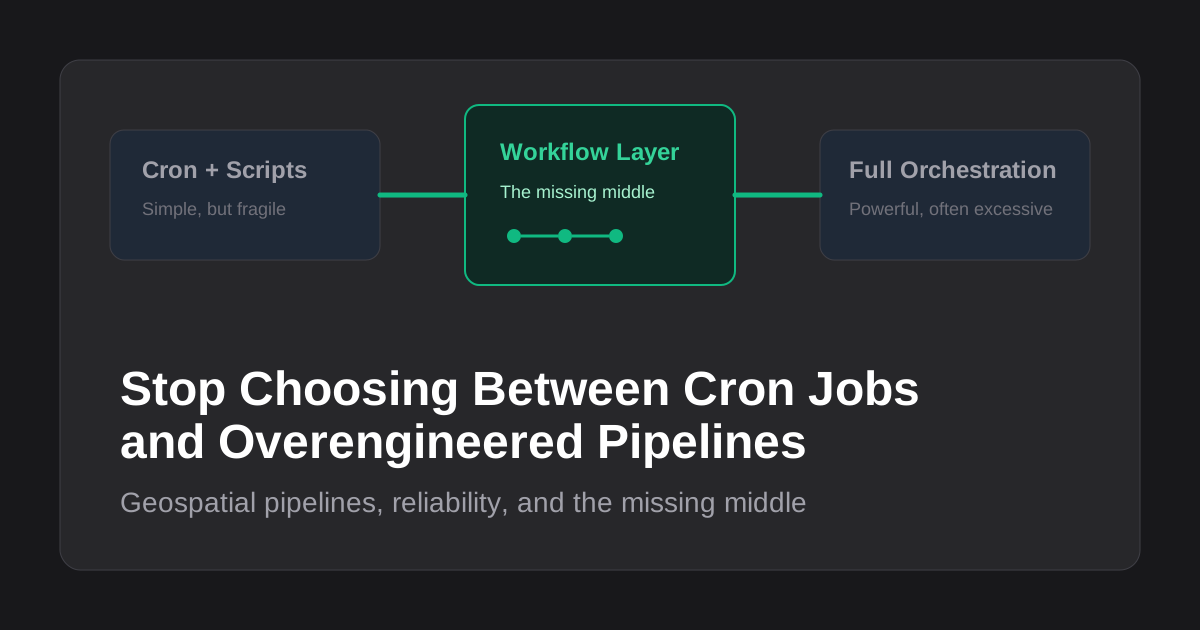
The decision most teams get wrong
Most teams building geospatial pipelines end up in one of two extremes: scripts and cron jobs that "just work," or fully orchestrated platforms that are heavy to build and run.
Both are common. Neither is a good default.
The real issue is not tooling availability. It is choosing complexity based on perceived scale instead of operational needs.
You can see this in two common scenarios:
- radar updates published every 10 minutes in NetCDF, then transformed and published for map visualization;
- cadastral data in PostGIS that must stay synced with vector tiles in S3, with about a 10-minute acceptable delay.
These pipelines have different workloads, but teams still overcorrect in both directions: under-structured scripts for the lighter flow, over-engineered orchestration for the heavier one.
Two extremes that don’t scale
Script + cron setups are fast to start, but fragile in production. They assume data arrives on time, steps succeed, and failures are rare. In reality, failures are normal, which leads to silent breakages and painful debugging.
At the other end, platforms like Argo Workflows add explicit retries and control, but also add operational cost, slower iteration, and infrastructure overhead that many geospatial teams do not need.
The result is the same in both cases: poor fit between system complexity and real constraints.
The missing middle
There is a third option: a workflow layer that adds structure without excessive overhead.
In our case, that layer is n8n. Pipelines become explicit workflows with visible state, controlled execution order, and built-in retry paths. The model shifts from "run scripts on a schedule" to "execute workflows based on state and events."
To support geospatial workloads, we run this with a custom environment that includes GDAL, PDAL, Tippecanoe, and QGIS. Processing and orchestration live in one consistent layer.
Where this matters in operations
The value is most visible when something breaks.
In one real incident, we got a 2AM call: "radar stopped showing on the map." The root cause was simple (invalid upstream input), but tracing it in a complex setup took nearly an hour.
That is the key point: reliability is not enough if diagnosis is slow.
With a workflow-first model, failure points are explicit, intermediate inputs are inspectable, and reruns are targeted. Teams move from reactive log forensics to controlled operations with visibility.
From workflows to systems: introducing Ordo
Once execution is stable, the next bottleneck is standardization.
Across projects, the same workflow patterns repeat (ingest, process, transform, publish), but each pipeline is often rebuilt with slight variations.
This led to Ordo, a control layer above execution.
Ordo is not another workflow engine. It defines, validates, and tracks pipelines as structured jobs. Pipelines are modeled as deterministic DAGs with explicit step contracts and named artifacts.
A pipeline definition in Ordo is essentially a recipe:
- a sequence of typed steps
- explicit input and output bindings between those steps
- declared parameters (without concrete values)
- and a fully defined artifact flow from start to finish
At runtime, jobs instantiate those recipes with concrete inputs and expected outputs. Execution can stay in n8n, while Ordo remains the source of truth for structure and state.
In practice, this removes implicit logic:
- no more guessing which step produced which file
- no more ad-hoc parameter passing between scripts
- no more unclear data dependencies
- no more duplicated pipeline definitions across projects
Instead, pipelines become explicit, inspectable, and repeatable.
If n8n provides a way to execute workflows, Ordo provides a way to define them with structure, enforce correctness before execution, and track their state as they run.
Takeaways
Geospatial pipelines usually fail not because of missing tools, but because complexity is mismatched to the problem.
Script-based setups are simple but fragile. Full orchestration is powerful but often excessive. A workflow layer is the practical middle ground for reliability, visibility, and iteration speed.
And once execution is stable, standardization becomes the next leverage point, which is where Ordo fits.
Next step
If you are dealing with unreliable updates, manual fixes, or limited visibility, the problem is usually structural, not tool-specific.
We have implemented this approach across different environments and use cases. If useful, we can review your current setup and identify your main constraints.